How Long for Marijuana Seeds to Break Soil?
Jun
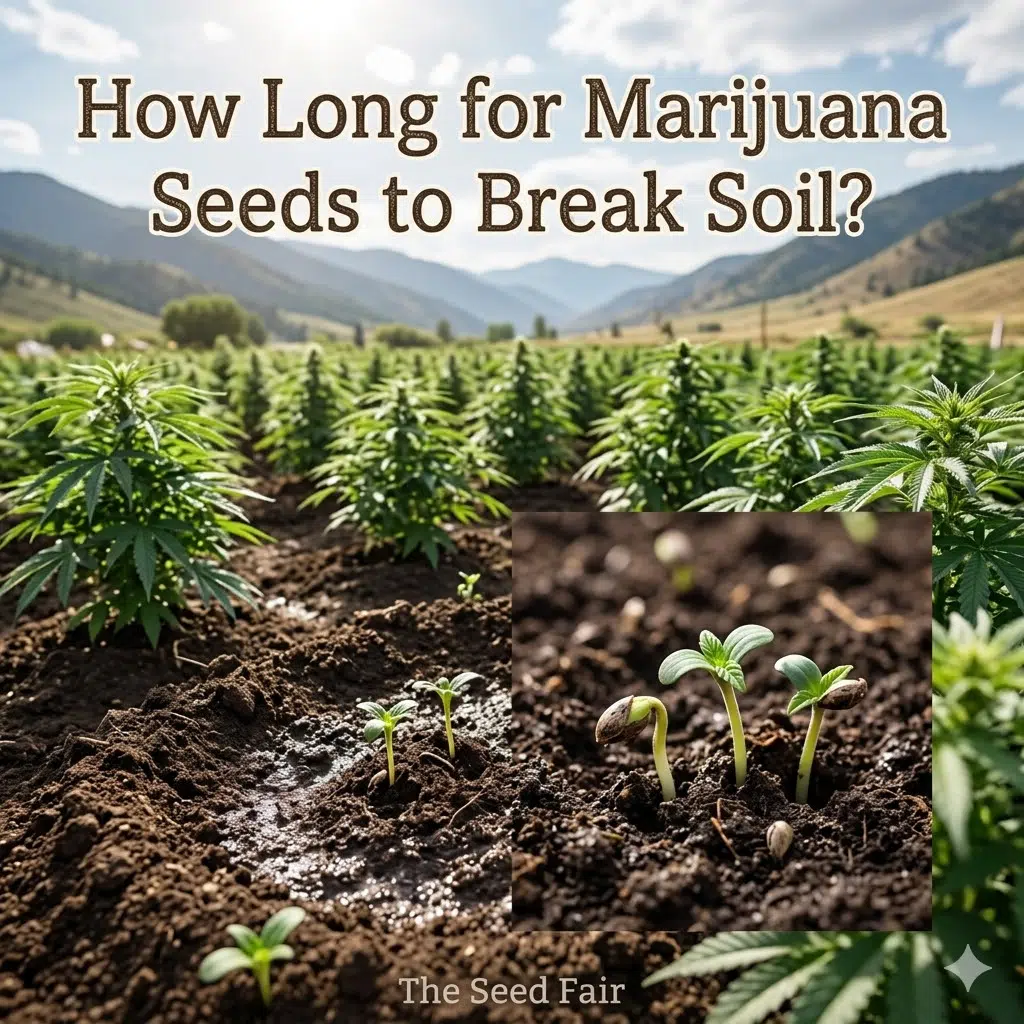
One of the most common questions new growers ask during germination is simple but important: how long does it take for marijuana seeds to break soil?
This moment — when a seed finally pushes through the surface — marks the transition from germination to early plant life. It’s often the most exciting stage for beginners because it confirms that the process is working.
But while many guides give a fixed timeline, experienced growers know the reality is more nuanced. Seed emergence is not just about time — it’s about environmental stability, seed quality, and how well the early root system develops underground before anything becomes visible above the soil.
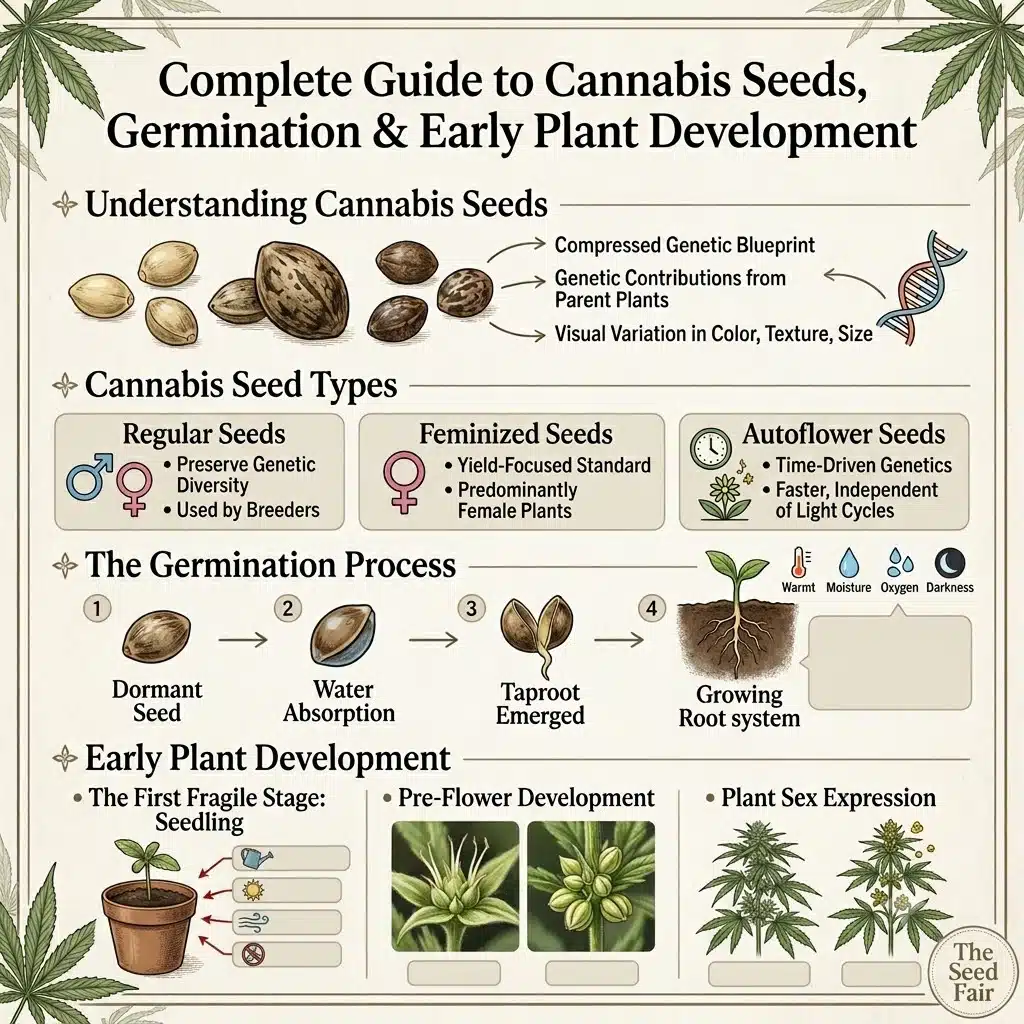
Understanding this stage properly helps prevent overwatering, premature intervention, and unnecessary disturbance while early development continues below the surface. Seed emergence is one part of the broader relationship between cannabis seeds, germination, and early plant development that begins before any growth becomes visible above the soil.
What Actually Happens Before a Seed Breaks Soil
Before a cannabis seed ever appears above the surface, most of the action is happening out of sight.
Once moisture activates the seed, it begins absorbing water and expanding. This triggers internal enzyme activity, which signals the embryo to begin growth. The first visible structure to form is the taproot, which anchors downward into the growing medium.
As the first root extends into the growing medium, the emerging shoot begins moving upward toward the surface. These processes overlap, with early root growth and shoot emergence developing as part of the same transition into seedling growth. The shoot must physically travel through the soil before it becomes visible at the surface.
This is why breaking soil is not the start of growth — it is the end result of several hidden biological processes already underway.
Many new growers mistake silence for failure during this phase, when in reality, the seed is often working exactly as expected beneath the surface.
Average Time for Marijuana Seeds to Break Soil
Under stable conditions, most cannabis seeds take around 2 to 7 days to break through the soil.
However, this range is not fixed. Some seeds emerge in as little as 48 hours, while others may take over a week depending on environmental factors and genetics.
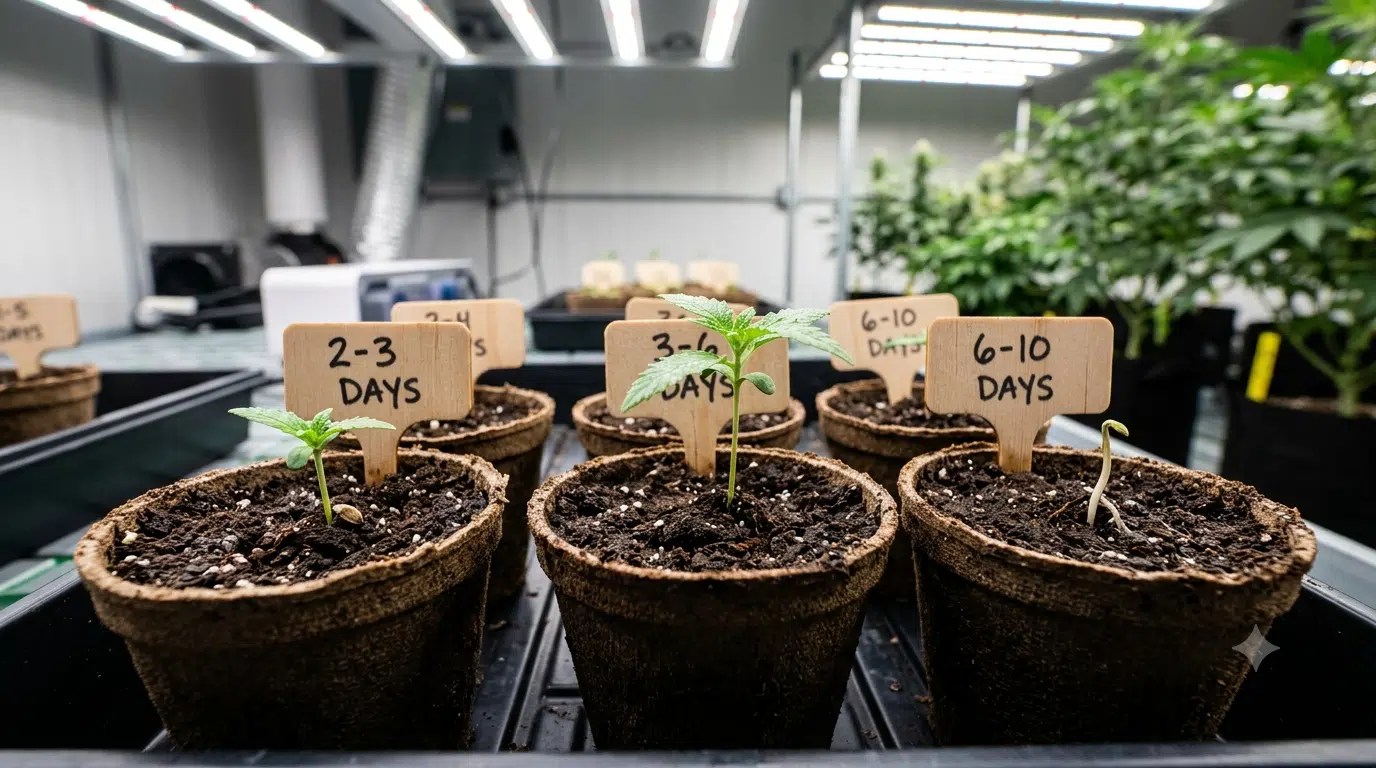
From real grow experience, the most consistent pattern looks like this:
- Fast-responding seeds: 2–3 days
- Average germination: 3–6 days
- Slower or older seeds: 6–10 days
Anything beyond this usually signals either environmental imbalance or a non-viable seed.
One important insight many growers learn over time is that soil emergence speed is less about the seed itself and more about how smoothly the root system develops before surfacing.
Why Some Seeds Take Longer to Break Soil
When a seed takes longer than expected to emerge, it usually comes down to environmental resistance rather than genetics alone.
The most common factor is inconsistent moisture. If the growing medium cycles between too dry and too wet, the seed may pause development. Roots need steady hydration to maintain momentum — interruptions slow everything down.
Temperature also plays a major role. Cooler environments slow metabolic activity inside the seed, which delays root expansion. On the other hand, overly warm conditions can stress early development and reduce consistency.
Growing-medium structure is another important factor. Dense or waterlogged soil can restrict oxygen availability and create greater resistance around the emerging seedling, while excessive planting depth increases the distance the shoot must travel before reaching the surface.
These factors become especially important when planting marijuana seeds directly in soil, because moisture, depth, and medium structure must remain balanced from the beginning.
In practice, the best results come from a balanced medium that allows both oxygen flow and root support without resistance.
Genetics and Seed Type Influence Timing
While environmental conditions are the main driver of emergence speed, genetics also play a role.
Different cannabis seed types behave slightly differently during early growth:
- Photoperiod strains tend to show more variation depending on genetics and breeder selection
- Feminized seeds are generally more consistent in performance due to stabilized genetics
- Autoflowering seeds often germinate quickly but still depend heavily on environmental stability during emergence
However, one key takeaway from experienced growers is that seed type does not override poor conditions. Even fast genetics will slow down if the environment is unstable.
This is why many growers focus more on dialing in their setup than choosing seeds based purely on germination speed.
The Role of Moisture in Breaking Soil
Moisture is the most influential factor in whether and how quickly a seed breaks soil.
Cannabis seeds require a consistently moist environment to maintain internal activation. However, there is a narrow balance between “moist” and “saturated.”
Too little moisture and the seed stalls. Too much and oxygen is restricted, which slows or stops root development.
Experienced growers often judge moisture not by appearance, but by feel — the medium should stay lightly damp without becoming heavy or waterlogged.
One practical observation from real grows is that seeds emerging fastest are rarely those in the wettest medium — they are the ones in the most consistently balanced medium.
Temperature Stability and Emergence Speed
Temperature directly affects how quickly a seed moves from root formation to surface emergence.
Cannabis seeds generally perform best in a warm, stable range. Within this range, enzymatic activity remains consistent and root development progresses smoothly.
When temperatures drop too low, emergence slows significantly. Seeds may remain alive but inactive, creating the impression of failure when they are simply delayed.
When temperatures fluctuate heavily between day and night, seedlings often emerge unevenly or stall midway through the soil.
Consistency is more important than peak warmth. Stable conditions create predictable emergence timelines.
What It Looks Like When a Seed Is About to Break Soil
Most growers eventually learn to recognize subtle signs that a seed is close to emerging.
Just before breaking the surface, the seedling often pushes the soil upward slightly. A small crack or lift in the medium may become visible. This is the moment when the shoot is forcing its way upward through resistance.
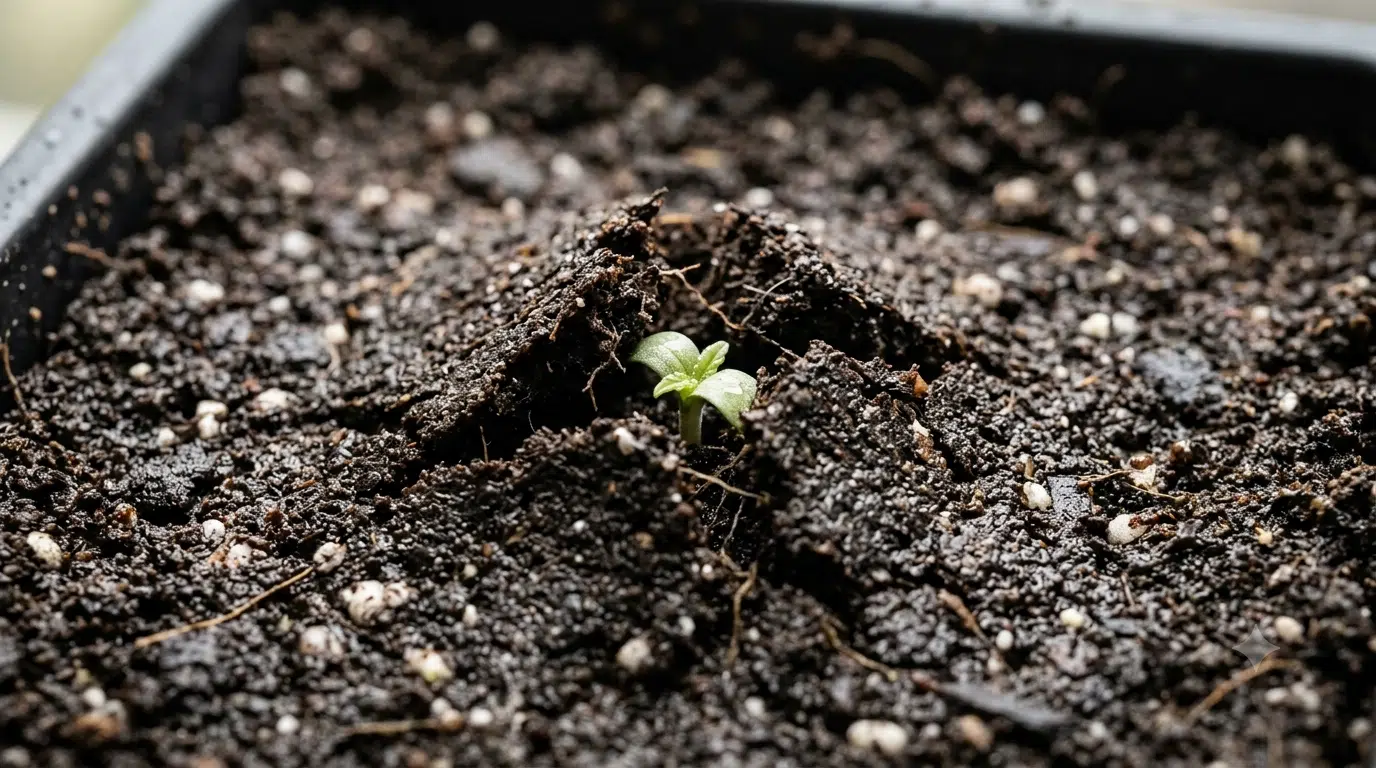
At this stage, intervention is not needed. In fact, disturbing the soil can damage the fragile structure underneath.
One of the most common beginner mistakes is digging to “check progress,” which often does more harm than waiting patiently.
Emergence is a mechanical process as much as a biological one, and interference can easily disrupt it.
What to Do If Seeds Are Slow to Break Soil
If a seed has not emerged within the expected timeframe, the first step is not to panic or dig it up.
Experienced growers typically reassess environmental conditions first. Moisture consistency, temperature stability, and soil density are usually the root causes of delays.
If conditions appear stable and there is still no emergence after additional time, avoid assuming immediately that the seed is dead. Delays may involve planting depth, excess moisture, low temperature, poor oxygen availability, seed age, or reduced viability.
When there is still no visible progress, the next step is to work through the most common reasons cannabis seeds fail to germinate before disturbing the seed unnecessarily.
This is normal in any batch of seeds — not every seed will perform at the same level, even under ideal conditions.
The key is to avoid constant adjustment during the waiting period. Stability is what allows delayed seeds to recover.
Final Takeaway
The question “how long does it take for marijuana seeds to break soil” has a simple answer on paper, but a more complex reality in practice.
On average, cannabis seeds emerge in 2 to 7 days, but the real determinant is environmental stability rather than time itself.
When moisture, temperature, and medium quality are properly balanced, seeds tend to break soil quickly and predictably. When any of these factors fluctuate, emergence slows or becomes inconsistent.
From a grower’s perspective, breaking soil is not just a milestone — it is a feedback signal. It tells you whether your early cultivation environment is truly dialed in.
Once you understand that, seed emergence stops being a waiting game and becomes the first real indicator of grow success.

Alexander Broodryk is a very skilled grower and has been writing about his experiences online for many years. With over 5 years in the Cannabis Industry Alexander is not only engaging with many of his audiences but also informational. Alex has a lot of writings about Cannabis all over online and we are very happy to have him here at The Seed Fair helping to contribute his well thorough content for our website. He is dedicated to educating readers on the latest developments and trends in this rapidly evolving market. Check out his biography under our Author pages at Alexander Broodryk, Author at The Seed Fair.