How to Grow Weed in a Closet (Complete Small-Space Indoor Growing Guide)
Jun
Growing weed in a closet is one of the most practical ways to start indoor cultivation when space is limited. In fact, many indoor growers begin exactly this way before scaling up to grow tents or full rooms.
A closet grow works because it gives you something outdoor environments cannot: full environmental control in a small, contained footprint. With the right setup, you can manage lighting cycles, airflow, humidity, and odor in a way that keeps plants stable and discreet.
A closet setup relies on the same environmental principles as any other indoor grow, but the smaller air volume leaves less room for error. Our complete guide to indoor cannabis cultivation explains how lighting, ventilation, humidity, temperature, and canopy management work together across the full grow cycle.
Why Closets Work for Indoor Cannabis Growing
A closet is often underestimated as a potential grow space. It is not just a storage space — it becomes a controlled micro-environment when properly set up.
What makes closets effective is stability. Unlike open rooms, a closet naturally blocks light leaks and helps maintain a more consistent temperature range. That stability reduces plant stress, especially during early vegetative growth.
However, the tradeoff is clear: airflow and heat management become more difficult, and mistakes scale quickly in a small space.
Key advantages of closet growing:
- Natural light sealing (good for 12/12 flowering control)
- Easy environmental isolation
- Lower setup cost compared to tents
- Better discretion in apartments or shared housing
Main limitations:
- Heat builds up quickly
- Limited vertical space
- Air exchange is restricted
- Odor accumulates faster without filtration
Closet growing succeeds or fails based on how well you manage these limitations.
Preparing Your Closet Grow Space
Before adding any plants, preparation is where most success is determined. A closet grow is not about improvisation — it’s about building a stable system inside a confined box.
Cleaning and sealing the space
A proper setup starts with a clean environment. Any dust, fabric particles, or moisture traps can create mold risks later in the cycle.
A thorough cleaning and sealing obvious light gaps can reduce avoidable contamination risks and make the space easier to manage.
Light optimization inside a closet
Closets are usually dark, which is good — but reflectivity matters just as much as darkness control.
Most growers line walls with:
- White paint (basic but effective)
- Mylar reflective film (higher efficiency)
- Light-blocking black/white poly sheets
This improves light bounce and prevents wasted energy, especially in small LED setups.
Lighting Setup for Closet Cannabis Growth
Lighting is the engine of indoor cannabis growth. In a closet, this becomes even more important because you rely entirely on artificial light cycles.
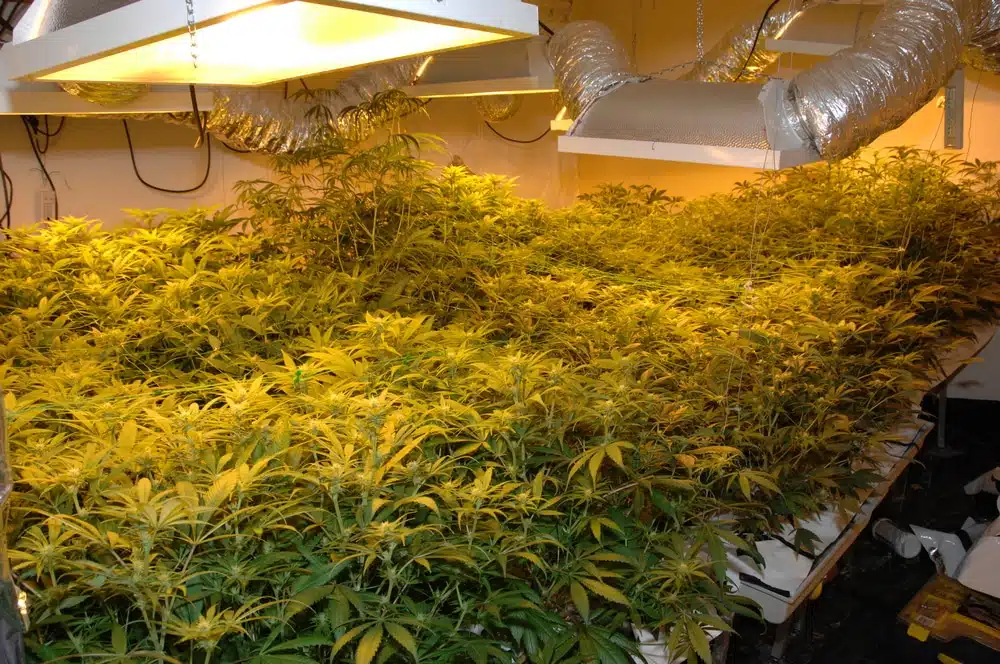
LED systems are often better suited to closet environments because they provide strong light intensity with less heat than many traditional HID setups.
Best lighting options:
LED Grow Lights (Recommended)
LEDs are ideal because they produce strong light with low heat output. In tight spaces, heat control is everything.
They also allow:
- Adjustable intensity
- Lower electricity usage
- Minimal noise
- Long lifespan
Fluorescent Lights (Seedlings only)
These are useful for early-stage growth but lack intensity for flowering.
HID Lighting (Advanced setups)
HID systems produce strong yields but generate too much heat for most closet environments unless heavily ventilated.
Airflow and Ventilation in Closet Grows
If there is one factor that determines success in closet cultivation, it is airflow.
Without proper air exchange, plants quickly show stress: drooping leaves, heat stress, and slower growth.
In small spaces, air becomes stagnant fast, which directly impacts CO₂ availability and transpiration.
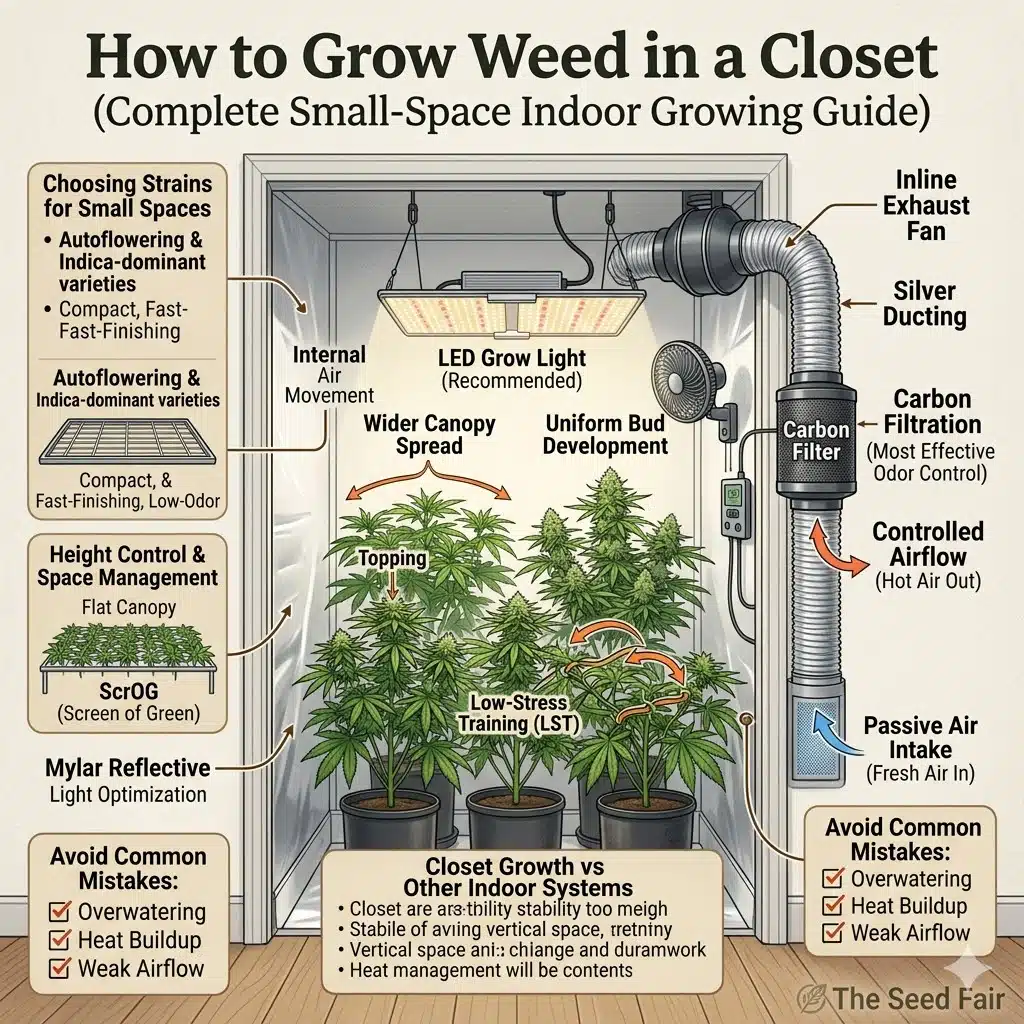
Basic airflow setup:
- One intake fan (fresh air in)
- One exhaust fan (hot air out)
- Small oscillating fan (internal movement)
Even simple airflow creates a major improvement in plant structure and stem strength.
Improving air exchange can reduce heat buildup, support transpiration, and prevent stagnant conditions around the canopy.
Managing Odor in a Closet Grow
Odor is one of the biggest concerns in small indoor spaces. Odor becomes more difficult to contain during flowering as aromatic compounds become increasingly concentrated and the enclosed space offers little opportunity for passive dispersion.
Closets amplify smell because air has no natural dispersion path.
Best odor control methods:
- Carbon filtration system (most effective)
- Sealed door edges
- Negative pressure airflow
- Passive odor neutralizers outside the grow space
Activated carbon filters are widely used because they adsorb many odor-causing compounds as air passes through the filter media.
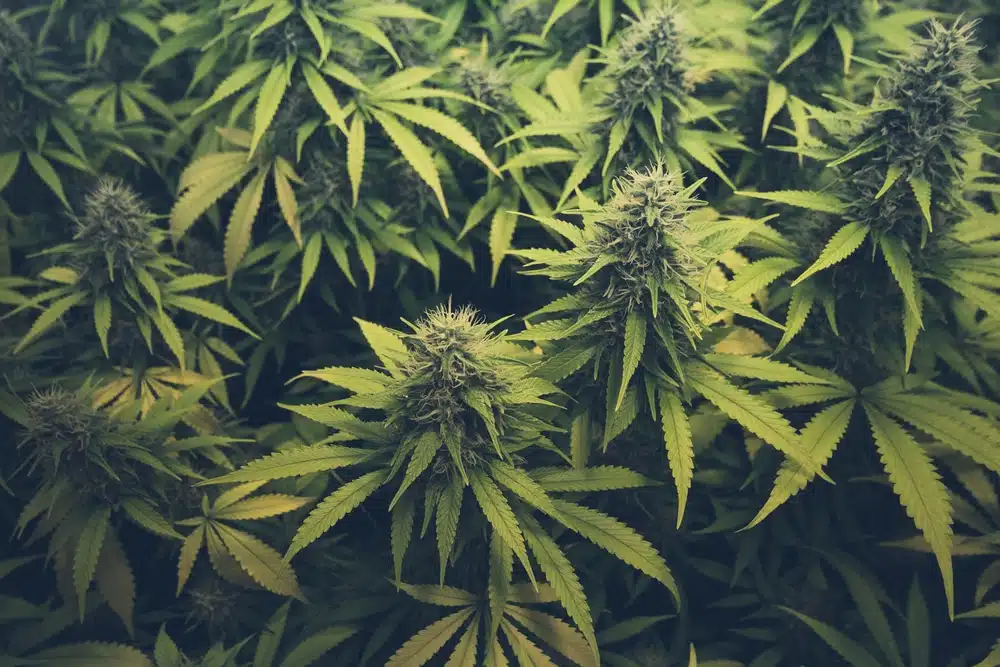
When airflow is balanced correctly, odor control becomes easier because odor-rich air is directed toward the exhaust and filtration system instead of leaking outward If odor remains noticeable outside the closet, our guide to growing marijuana indoors without smell covers carbon filtration, negative pressure, air leakage, and ventilation failures in greater depth.
Best Cannabis Strains for Closet Growing
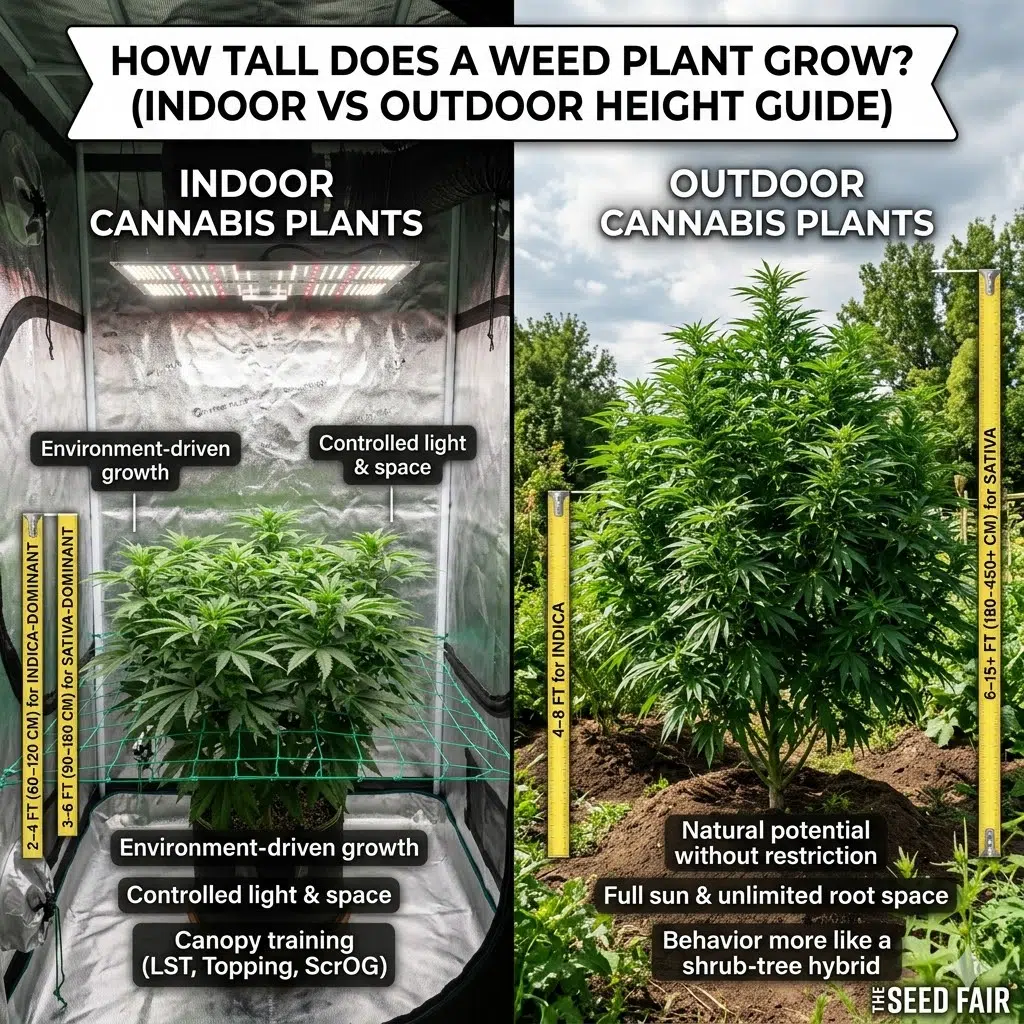
Genetics influence final height, flowering stretch, branching structure, and aroma intensity. In a closet, cultivars with aggressive vertical growth can become difficult to manage once the canopy approaches the lighting system.
Closet growers should prioritize compact, fast-finishing strains. Growers working with strict vertical limits can use our guide to cannabis plant height to compare how genetics, vegetative time, and flowering stretch influence final size.
Ideal strain types:
- Low-odor phenotypes
Why autoflowers work well:
Many autoflowering varieties remain relatively compact, begin flowering according to age rather than a 12/12 light-cycle change, and can be easier to plan around in restricted spaces.
For some new growers, this simplified flowering schedule can make compact indoor planning more straightforward.
Managing Plant Height in Small Spaces
Height control becomes essential very early in closet cultivation.
Without training, plants can quickly outgrow available space and reduce light efficiency. Without early training, branches can crowd the light, overlap neighboring growth, and restrict airflow through the interior canopy.
Effective height control techniques:
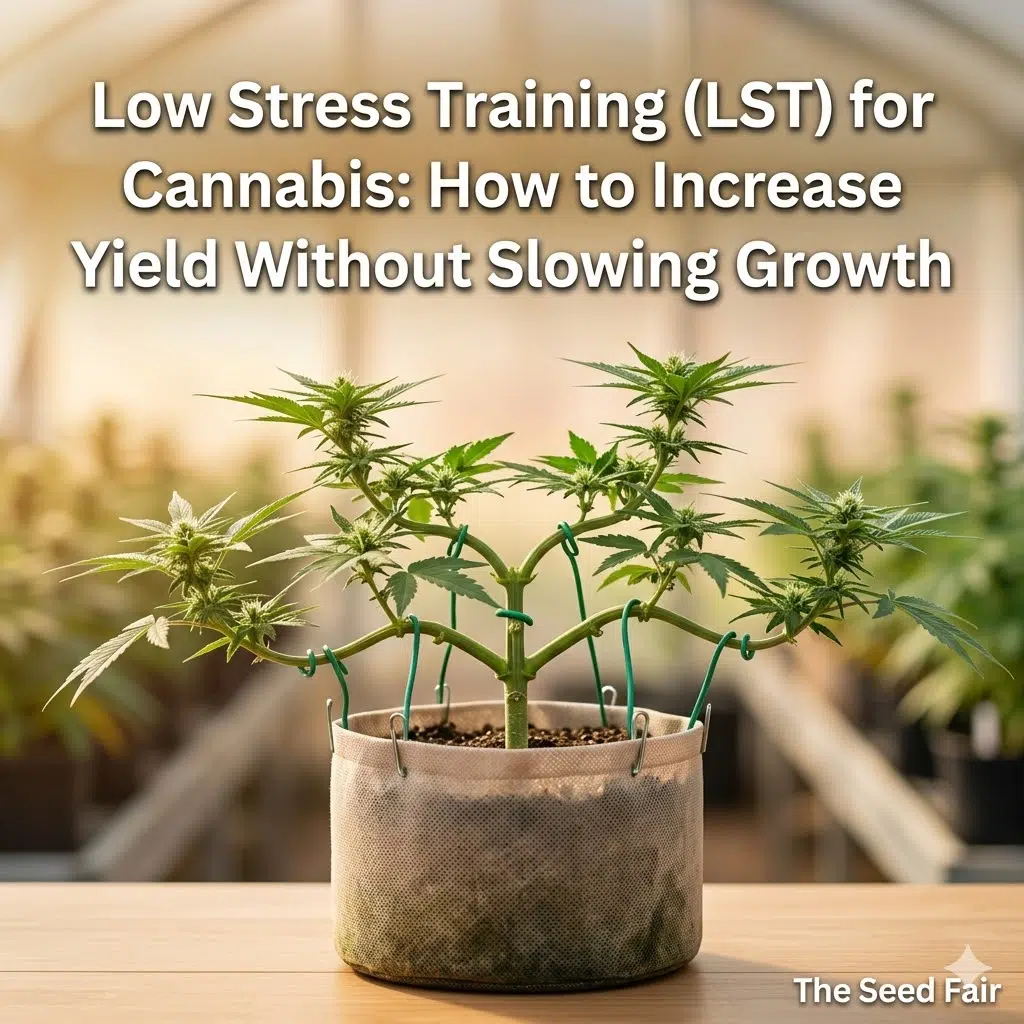
- Low-stress training (LST)
- Topping during vegetative stage
- Early transition to flowering
- Horizontal canopy training (ScrOG style)
These techniques improve light distribution while preventing plants from growing too close to lights. If the plant has already exceeded the available space, our guide to recognizing and correcting overgrown cannabis plants explains the warning signs and practical options in more detail.
In small environments, structure matters more than size.
Common Mistakes in Closet Growing
Closet grows fail for predictable reasons. Most issues are environmental, not genetic.
Common mistakes:
- Overwatering due to small soil volume
- Poor airflow leading to heat stress
- Ignoring odor buildup early
- Letting plants grow vertically unchecked
- Using high-heat lighting systems
In many closet setups, heat accumulation combined with weak airflow creates problems before nutrient limitations become the main concern.
Closet Growing vs Other Indoor Systems
Closet setups sit between apartment grows and full grow tents in terms of control and scalability. Closet setups share many of the same constraints as other compact indoor environments, including limited airflow, heat accumulation, odor containment, and restricted vertical space.
Compared to apartments:
- Better light sealing
- More controlled environment
Compared to grow tents:
- Less airflow efficiency
- More difficult heat management
This is why most growers eventually transition from closets to tents as they scale, but closets remain one of the best entry points into indoor cultivation systems.
Final Takeaway
Growing weed in a closet is one of the most efficient ways to understand indoor cultivation because it forces you to focus on environmental control at a small scale.
When lighting, airflow, odor control, and plant training are balanced correctly, even a simple closet setup can produce stable, high-quality growth cycles.
Closet growing is not about size — it is about control. And once you understand how each environmental variable interacts in a small space, you understand the foundation of indoor cultivation itself.

Alexander Broodryk is a very skilled grower and has been writing about his experiences online for many years. With over 5 years in the Cannabis Industry Alexander is not only engaging with many of his audiences but also informational. Alex has a lot of writings about Cannabis all over online and we are very happy to have him here at The Seed Fair helping to contribute his well thorough content for our website. He is dedicated to educating readers on the latest developments and trends in this rapidly evolving market. Check out his biography under our Author pages at Alexander Broodryk, Author at The Seed Fair.