How to Germinate a Marijuana Seed (Step-by-Step Guide for Consistent Results)
Jun
Successful cannabis cultivation always begins with one simple process: germination. No matter how advanced your grow setup is, everything depends on whether your seeds can successfully transition from dormancy into active growth.
Germination is the stage where a cannabis seed absorbs moisture, activates internal enzymes, and begins forming its first root system. While the process sounds simple, small mistakes at this stage often determine the strength and health of the entire plant later on.
In real cultivation environments, germination is less about complex technique and more about consistency—stable moisture, proper temperature, and minimal disturbance.
Germination is only the first part of early plant development. Our complete guide to cannabis seeds and early plant development explains how seed genetics, viability, germination, emergence, and early growth connect across the beginning of the cultivation cycle.
What Happens During Cannabis Seed Germination
A cannabis seed is biologically designed to stay dormant until conditions are right for growth. Inside the shell is a fully formed embryo that only needs moisture, oxygen, and warmth to activate.
Once water penetrates the shell, internal enzymes begin breaking down stored energy. The seed swells, the shell softens, and a taproot emerges. That taproot becomes the foundation of the entire plant’s root system.
From experience, this stage is extremely sensitive. The seed is not “strong” yet—it is transitioning from dormancy to life. Any instability in moisture or temperature can slow or stop the process entirely.
The key idea to understand is simple:
you are not forcing growth—you are creating safe conditions for it to begin naturally.
Why Germination Quality Impacts the Entire Grow
Many beginners underestimate germination because it only lasts a few days. In reality, it sets the foundation for everything that follows.
A properly germinated seed tends to develop:
- Stronger root structure
- Faster early vegetative growth
- Better nutrient uptake later in life
- Improved resistance to stress
- More stable overall plant development
In contrast, poorly germinated seeds often show weak early growth, slower development, and reduced vigor throughout the cycle.
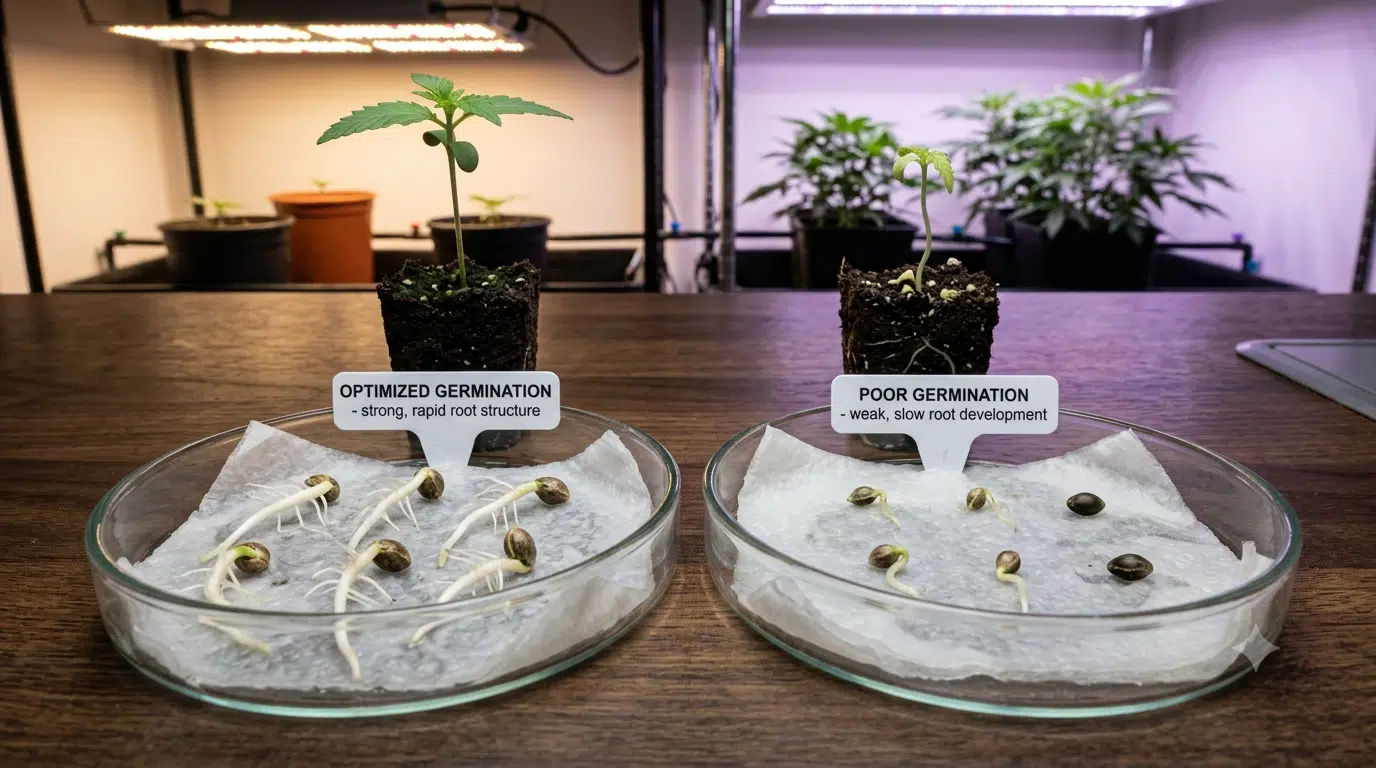
Experienced growers often say that the “quality of the harvest is decided before the plant even reaches soil.” While that sounds exaggerated, in practice it reflects how important early root formation really is.
Choosing the Right Cannabis Seeds Before Germination
Before starting germination, seed quality matters more than method.
Seed appearance can provide limited clues about maturity, but it cannot confirm viability on its own. Mature cannabis seeds are often firm and may appear tan, brown, gray, mottled, or striped depending on the cultivar and seed lot.
Before germination, the factors that matter most include:
- Seed maturity
- Storage conditions
- Seed age
- Exposure to heat or moisture
- Physical damage
- Overall genetic quality
A dark or heavily patterned seed is not automatically more viable than a lighter seed, which is why appearance should be treated as only one limited observation rather than a guarantee of germination success.
Good germination starts with good genetics and proper storage. Seeds kept in cool, dark, dry environments consistently outperform those exposed to heat or humidity over time.
Best Methods to Germinate Marijuana Seeds
There are several reliable ways to germinate cannabis seeds. Each method works because it provides the same three conditions: moisture, oxygen, and warmth.
In practice, growers choose based on experience level, control preference, and environment.
Paper Towel Method (Most Controlled Approach)
The paper towel method is one of the most widely used techniques because it allows full visibility and control during germination.
Seeds are placed between two damp paper towels and stored inside a covered container or plate in a warm, dark environment.
This setup creates a stable micro-environment where moisture is consistent but not excessive. Within a few days, the seed begins to crack and a taproot appears.
From experience, this method is popular because it allows growers to monitor progress daily without disturbing the seed. You can clearly see when the taproot emerges and transplant at the right moment.
The only real risk is inconsistency in moisture. If towels dry out or become oversaturated, germination success drops.
Direct Soil Germination (Most Natural Method)
Direct soil germination is the simplest and most natural approach. The seed is placed directly into a small hole in moist soil and left to germinate in place.
The biggest advantage here is stability. The seed is never moved, which eliminates transplant shock completely.
This method is often preferred by outdoor growers or those who want a low-intervention process. It closely mimics how cannabis would naturally germinate in soil environments.
However, the tradeoff is visibility. You cannot monitor root development directly, so timing and patience are essential.
Growers considering this approach can use our guide to planting cannabis seeds directly in soil for a more detailed look at planting depth, moisture control, emergence timing, and common direct-sowing mistakes.
Water Soaking Method (Fast Activation Technique)
The water soaking method involves placing seeds in a glass of room-temperature water to initiate germination quickly.
Seeds absorb moisture directly, which accelerates the internal activation process. Many viable seeds begin cracking within 24–72 hours using this method.
This technique is especially useful for older seeds with harder shells, as water helps soften the outer coating and trigger faster hydration.
However, seeds should not be left submerged for too long. Extended soaking can reduce oxygen availability and increase the risk of rot.
From experience, this method works best as a short pre-germination step rather than a full germination environment. Growers who begin by soaking cannabis seeds in water should watch for hydration, shell changes, and early signs that the seed is ready to move into the next stage.
What to Do After the Seed Sprouts
Once the taproot appears, the seed has officially entered the seedling stage and must be handled carefully.
At this point, the root is extremely fragile. Even minor damage can affect long-term plant development.
The seed is typically placed into soil or a growing medium with the taproot facing downward at a shallow depth.
One of the most common mistakes here is overhandling. Moving the seed too much or planting too deep can slow emergence or damage early root growth.
In real growing conditions, this stage benefits most from stability—consistent moisture, mild lighting, and minimal interference.
Common Germination Problems (And Why They Happen)
When cannabis seeds fail to germinate, the issue is usually environmental rather than genetic.
The most common causes include:
- Excess moisture causing seed rot
- Low moisture preventing activation
- Temperatures that are too cold or too hot
- Poor seed quality or age degradation
- Physical damage during handling
- Contaminated water or growing environments
In practice, overwatering is one of the most frequent mistakes. Seeds need moisture—not saturation.
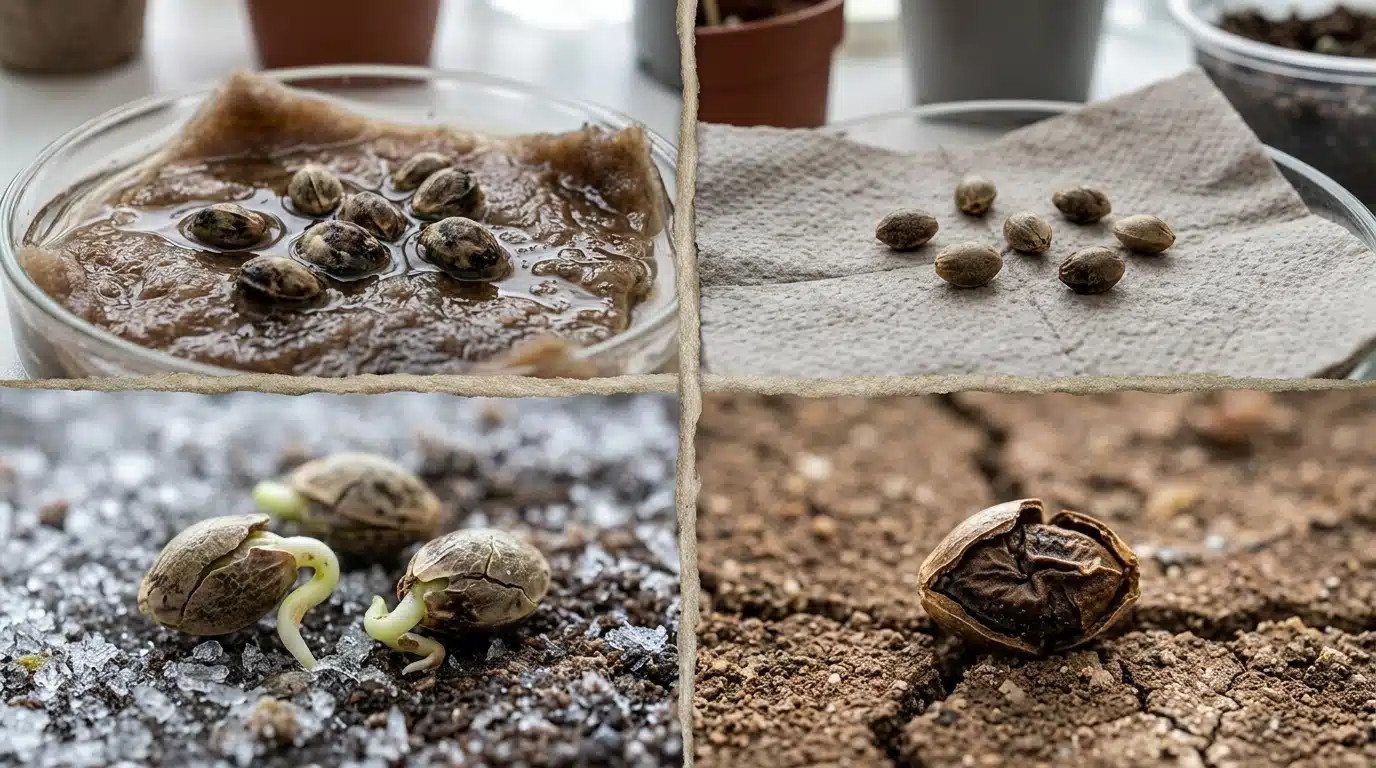
Another common issue is impatience. Some seeds take longer than others depending on genetics, and premature disturbance can interrupt the process. When cannabis seeds are not germinating as expected, the cause may involve temperature, moisture balance, seed age, oxygen availability, or reduced viability.
Improving Germination Success Like Experienced Growers
With experience, growers tend to simplify germination rather than complicate it.
Instead of adding additives or complex systems, they focus on consistency:
- Stable temperatures (warm but not hot)
- Clean, chlorine-free water
- Minimal physical handling
- Controlled humidity levels
- Fresh, viable seeds
One important shift that happens with experience is understanding that cannabis seeds already contain everything needed to grow. The goal is not to “help” them excessively, but to avoid creating stress.
In many real grows, the simplest setups often produce the most reliable results.
Final Takeaway
Germinating a marijuana seed is the first and most important step in cannabis cultivation.
While multiple methods exist—paper towel, soil, and water soaking—they all work because they provide the same core conditions needed for life to begin.
Success in germination doesn’t come from complexity. It comes from stability.
Once a seed successfully germinates and develops a healthy taproot, the foundation for the entire grow cycle is already set.
If you can consistently master germination, every other stage of cultivation becomes significantly easier to manage.

Alexander Broodryk is a very skilled grower and has been writing about his experiences online for many years. With over 5 years in the Cannabis Industry Alexander is not only engaging with many of his audiences but also informational. Alex has a lot of writings about Cannabis all over online and we are very happy to have him here at The Seed Fair helping to contribute his well thorough content for our website. He is dedicated to educating readers on the latest developments and trends in this rapidly evolving market. Check out his biography under our Author pages at Alexander Broodryk, Author at The Seed Fair.