Why Cannabis Seeds Don’t Germinate (And How to Fix It)
Jun
Every grower remembers the first time they opened a fresh pack of cannabis seeds. There’s a sense of anticipation in that moment — you’ve got genetics in your hands, and in theory, each seed is a future plant.
But in practice, not every seed cooperates.
Even when you follow the standard germination process carefully, it’s not uncommon for one or two seeds to refuse to sprout. Sometimes nothing happens at all. Other times, a seed cracks but never develops a healthy taproot.
Understanding why cannabis seeds fail to germinate is an important part of growing from seed because viability, moisture, oxygen, temperature, and early root development all influence what happens next. These factors are part of the broader relationship between cannabis seeds, germination, and early plant development that shapes the first stages of the grow.
This guide breaks down the real reasons cannabis seeds fail, what’s happening at a biological level, and how experienced growers troubleshoot stubborn seeds based on observation and environmental control rather than guesswork.
What Actually Happens When a Cannabis Seed Germinates
To understand why seeds fail, it helps to understand what success actually looks like.
Cannabis seed germination begins when moisture activates the internal enzymes inside the seed. Once triggered, the seed starts breaking dormancy and pushes out a taproot. This first root establishes the developing root axis, helps anchor the emerging seedling, and begins expanding the plant’s ability to absorb water and nutrients as development continues.
For germination to happen properly, three things must align:
- Stable moisture (not dry, not flooded)
- Oxygen availability
- A consistent temperature range
When any of these variables fall outside the optimal range, the seed may stall, delay, or fail completely.
Experienced growers often say germination is less about “making seeds sprout” and more about “not interrupting the process once it starts.”
The Most Common Reason Cannabis Seeds Don’t Sprout
In most failed germination cases, the issue is not genetics — it’s environment.
Cannabis seeds are resilient, but they are also sensitive during activation. A small imbalance in moisture or temperature can be enough to slow or stop development.
One of the most common mistakes is inconsistent moisture levels. Seeds may begin absorbing water and then experience drying before germination is complete. Repeated moisture fluctuations can interrupt the stable conditions needed for continued metabolic activity and early root development.
Another common issue is overwatering. While moisture is essential, too much water reduces oxygen availability around the seed. Without oxygen, the embryo inside cannot properly activate root growth.
In practice, successful germination is always a balance between hydration and airflow — something many beginners underestimate.
Temperature Instability and Slow Germination
Temperature plays a bigger role in germination than most growers realize.
Cannabis seeds typically prefer a stable, moderately warm environment. When temperatures drop too low, metabolic activity slows down. The seed remains dormant even if moisture is present.
On the other hand, excessive heat can damage internal seed structures before the taproot ever forms.
What experienced growers often notice is that seeds rarely fail instantly due to temperature — instead, they “sit still.” After several days with no visible change, temperature is usually one of the first things to re-evaluate.
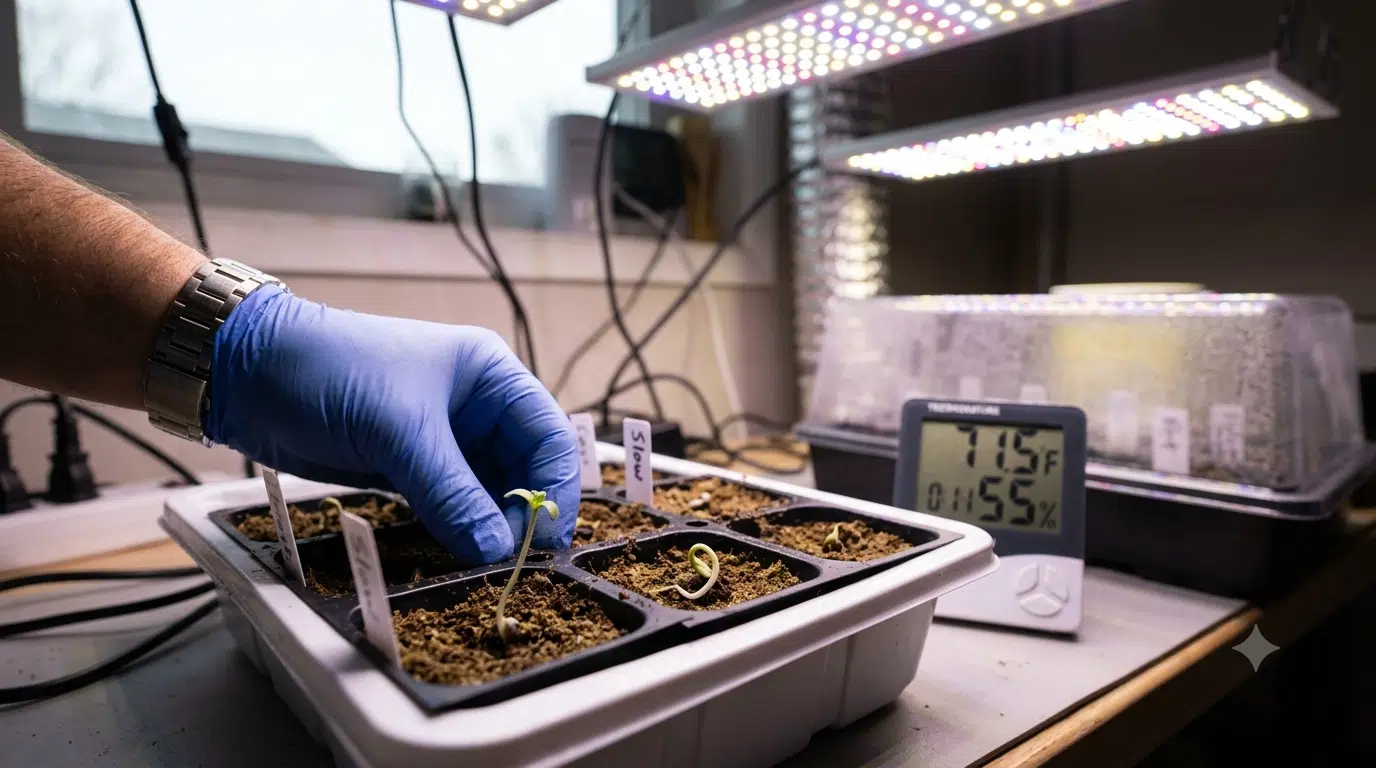
This is especially important in early indoor setups where heating sources, windows, or ventilation systems create micro-climates that fluctuate throughout the day.
Consistency matters more than intensity.
Seed Quality: The Factor Most Growers Overlook
Not all cannabis seeds are biologically equal. Even visually similar seeds can behave very differently during germination.
Seed viability depends on genetics, maturity at harvest, and how the seed was stored before it ever reached you.
Older seeds often take longer to respond. In some cases, they may require additional time or more controlled hydration to trigger activation. Seeds stored in unstable conditions may also have weakened membranes, making germination inconsistent.
A key detail experienced growers often rely on is seed structure. Firm, well-formed seeds generally have higher success rates than soft or slightly cracked ones.
However, it’s important not to assume that appearance alone determines viability. Some strong seeds look ordinary, while some visually “perfect” seeds fail due to internal issues.
This uncertainty is why growers focus more on environmental control than prediction.
Oxygen Starvation During Germination
One of the less obvious reasons seeds fail is oxygen deprivation.
Cannabis seeds need oxygen during early germination just as much as they need water. When seeds are fully submerged for too long or placed in overly saturated mediums, oxygen exchange slows down significantly.
This balance becomes especially important when seeds are started in water, where soaking time and the transition into a growing medium must be managed carefully to avoid prolonged submersion.
This creates a situation where the seed begins to activate but cannot sustain energy production. The result is a stalled or rotting seed.
This is why many growers prefer germination methods that maintain moisture without drowning the seed environment. The goal is always to keep the seed hydrated while still allowing airflow around it.
In real grow conditions, this balance is what separates fast, reliable germination from slow or inconsistent results.
Light Exposure and Germination Disruption
Cannabis seeds do not depend on light to begin germination. Before emergence, moisture, oxygen availability, temperature, and seed viability are generally more important than light exposure itself.
The practical concern with placing a germination setup in direct sunlight or near a strong light source is environmental instability. Containers, paper towels, or small volumes of water can warm quickly, while exposed materials may also lose moisture faster.
For that reason, growers often keep germinating seeds in a stable location where temperature and moisture can be controlled consistently. Once the seedling emerges above the growing medium, lighting becomes increasingly important for continued development.
Contamination and Handling Errors
Another common issue comes from handling.
Cannabis seeds may appear durable, but during germination they are vulnerable to contamination from oils, bacteria, or residue on hands and tools.
Even minor contamination can interfere with the seed coat or introduce pathogens that prevent successful taproot formation.
This is why experienced growers often use clean tools or avoid unnecessary handling altogether. The goal is simple: reduce contact, reduce risk.
In many failed germination cases, contamination is not obvious. The seed simply starts but fails shortly after, giving the impression of “random failure,” when in reality the environment was compromised early on.
When a Seed Starts But Doesn’t Continue Growing
Sometimes a seed will crack and even show a small taproot, but then development stops.
This is usually a sign of environmental interruption rather than total failure.
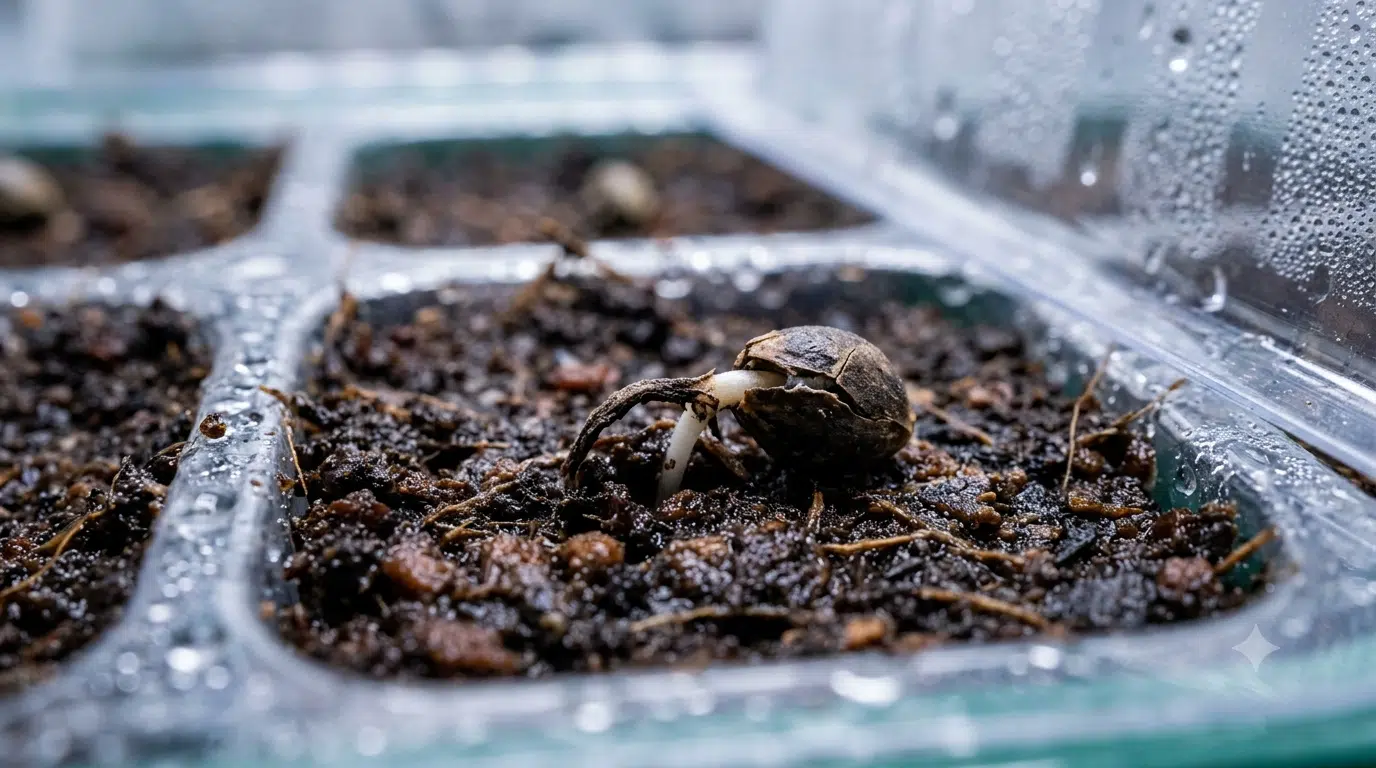
At this stage, the seed has already committed energy to growth. If moisture levels fluctuate, oxygen becomes limited, or temperature shifts too much, the seedling can stall permanently.
From a grower’s perspective, this is one of the most frustrating outcomes because it looks like success at first.
The key takeaway here is that germination doesn’t end when the seed cracks — it ends when the seedling is stable enough to transition into a growing medium.
What to Do When Seeds Don’t Germinate
When no visible progress appears within the expected timeframe, the first instinct is often to intervene aggressively. Before disturbing the seed, it helps to distinguish between a seed that has not germinated and one that may already be developing below the surface after planting. The expected time for a marijuana seed to break soil varies with planting depth, temperature, moisture, seed vigor, and growing conditions.
Experienced growers instead take a structured approach:
They reassess environmental conditions first — moisture consistency, temperature stability, and airflow balance. In many cases, small adjustments are enough to restart stalled seeds.
If a seed shows no progress after extended time, it may simply be non-viable. Not every seed in a batch will perform at the same level, even under ideal conditions.
This is normal in plant cultivation and part of why growers typically germinate multiple seeds at once rather than relying on a single one.
Final Takeaway: Germination Is a Stability Test, Not a Step
The biggest misconception among new growers is that germination is a simple step in the process.
In reality, germination is a stability test. It reveals how well environmental conditions are balanced before the plant even begins growing.
When seeds fail, it is rarely random. It is usually a reflection of small inconsistencies that went unnoticed — moisture cycles, temperature shifts, oxygen restriction, or handling errors.
Once growers start thinking in terms of environmental stability rather than “technique,” germination success rates increase naturally.
Healthy cannabis cultivation doesn’t begin with leaves or roots.
It begins with control, patience, and consistency at the seed level.

Alexander Broodryk is a very skilled grower and has been writing about his experiences online for many years. With over 5 years in the Cannabis Industry Alexander is not only engaging with many of his audiences but also informational. Alex has a lot of writings about Cannabis all over online and we are very happy to have him here at The Seed Fair helping to contribute his well thorough content for our website. He is dedicated to educating readers on the latest developments and trends in this rapidly evolving market. Check out his biography under our Author pages at Alexander Broodryk, Author at The Seed Fair.